24/7 Residential Service
Furnace Repair in Tacoma, WA
Furnaces are the workhorse of Tacoma home heating, and they fail in fairly predictable ways: ignition that won't hold, a safety switch that keeps opening, a blower that can't move enough air. We read the fault codes, test the sequence and repair the cause.
Call now FOR FREE QUOTE and for service availability. Please have your 5-digit ZIP code ready.
A forced-air furnace performs the same short play every time it runs. The thermostat calls. The inducer motor starts and the pressure switch confirms venting. The ignitor glows or the pilot proves. The gas valve opens. The flame sensor confirms flame within a few seconds. The blower starts once the exchanger warms. Then everything shuts down in reverse. When a furnace misbehaves, the act it stops on tells you a great deal about where to look.
Furnace faults we see most in Tacoma homes
Ignition lockouts
Hot-surface ignitors crack with age and thermal cycling. Flame sensors build up a film that keeps them from proving flame, so the board closes the gas valve within seconds of lighting. Both are common, both are undramatic repairs once identified, and both look identical from the hallway.
Limit switch trips
A high-limit switch opens when the cabinet gets hotter than it should. That is nearly always an airflow story — clogged filter, dirty blower wheel, closed registers, crushed flex duct in a crawlspace. Replacing the switch without fixing airflow just buys a few weeks.
Pressure switch and venting faults
High-efficiency furnaces vent through plastic pipe and drain condensate. A blocked intake, a sagging vent run holding water, or a plugged condensate trap will stop operation by design. In our wet season, vent terminations outside are worth a look.
Blower motor and capacitor failures
A weak capacitor can leave a motor humming and unable to start; a failing bearing announces itself with a squeal. Either way, heat without airflow leads straight back to a limit trip.
Control board and wiring problems
Boards fail, low-voltage fuses blow, and rodent damage in crawlspaces is more common than homeowners expect. Tracing the 24-volt circuit usually settles it quickly.
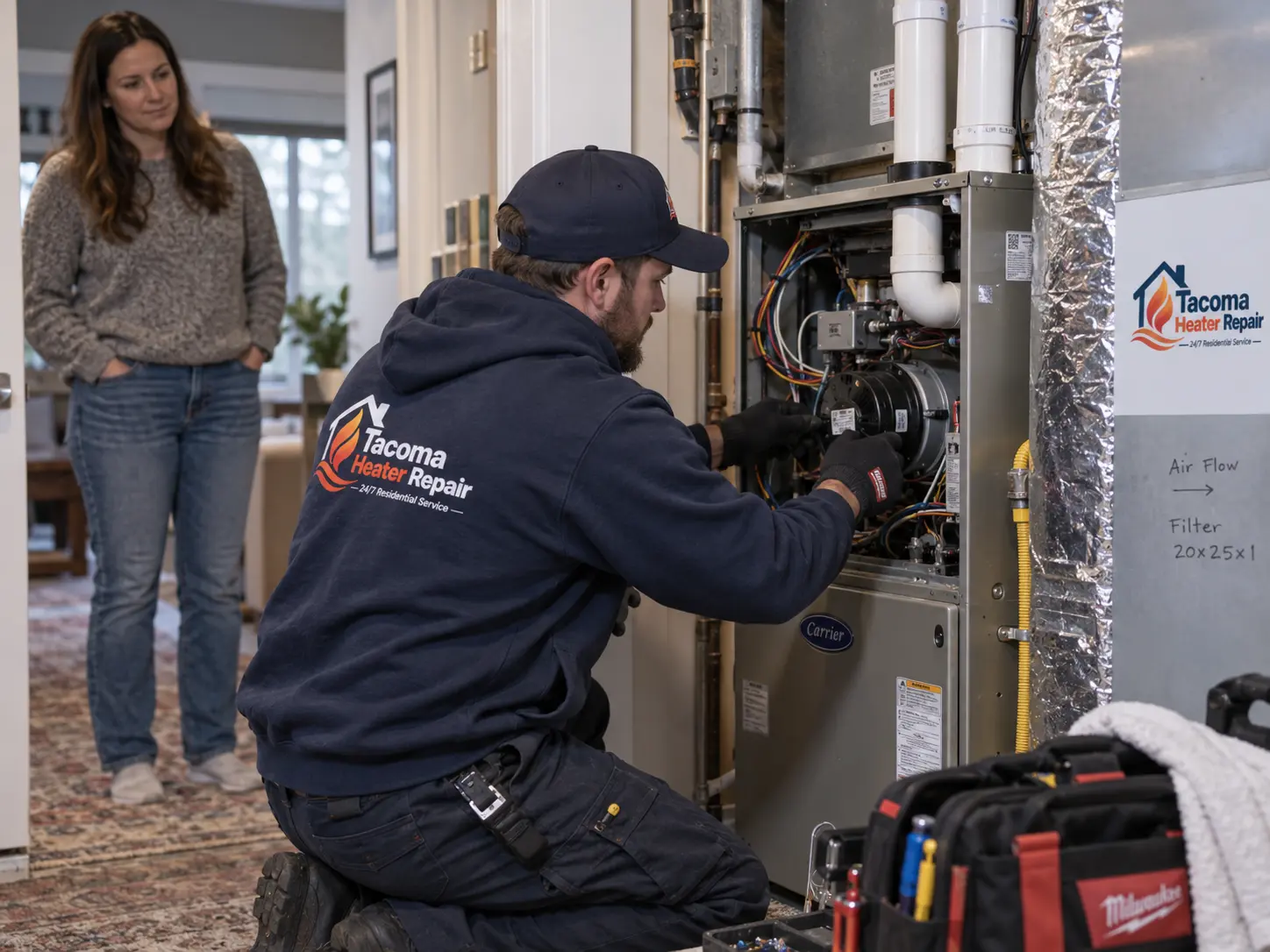
Signs your furnace needs repair
- Repeated ignition attempts followed by a shutdown
- A flashing diagnostic light in the furnace viewing window
- Cycles that end after a few minutes of heat
- A boom or whoosh at start-up (delayed ignition — treat as urgent)
- Squealing or scraping whenever the blower runs
- Soot marks, rusty streaking or water pooling around the cabinet
- Rooms noticeably behind the thermostat setting
Furnace out in the middle of a cold snap?
24/7 Residential Service in the Tacoma area.
Call now FOR FREE QUOTE and for service availability. Please have your 5-digit ZIP code ready.
Gas and electric furnaces
Gas furnaces bring combustion, venting and flame-proving into the picture. Electric furnaces trade all that for heating elements, sequencers and heavier current draw — the full picture is on our electric heater repair page. Airflow, filtration, blower condition and thermostat control matter equally on both.
Related components and pages
Furnace complaints frequently turn out to be control problems — see thermostat repair — or, in homes with hybrid systems, heat pump behavior covered on our heat pump repair page. For planning numbers, use the heater repair cost calculator, and why a heater keeps turning on and off covers short cycling in depth.
Homeowner FAQ
- Why does my furnace try to light three times and then stop?
- That pattern is an ignition lockout. The control board attempts ignition a set number of times, fails to confirm flame, and shuts the gas valve as a safety measure. A cracked ignitor, a fouled flame sensor, a venting or pressure-switch problem, or a gas-supply issue are the usual causes.
- What does a flashing light on my furnace mean?
- Most furnaces built in the last few decades flash a diagnostic code through the viewing window. The pattern maps to a specific fault — open limit, pressure switch, flame sense failure, and so on. Counting the flashes before you call genuinely speeds up diagnosis.
- Can I replace my own furnace filter?
- Yes, and you should. Note the size printed on the old filter, match the airflow arrow toward the furnace, and check it every one to three months during the heating season. It is the single most useful thing a homeowner can do for a forced-air furnace.
- My furnace smells like gas. What should I do?
- Leave the area if the smell is strong, then call your gas utility or 911 from outside before calling anyone else. Do not operate switches or try to inspect the furnace. Once the utility has cleared the situation, we can handle the repair side.
- Is a cracked heat exchanger repairable?
- Generally no — a cracked heat exchanger is a combustion-safety issue, and the accepted path is replacement of the exchanger or the furnace rather than a patch. If we find one, we will explain exactly what we saw and what your options are.
- How long does a furnace repair take?
- Diagnosis is usually the larger part of the visit. Common part replacements such as ignitors, flame sensors and capacitors are often completed the same visit; blower assemblies, gas valves and control boards depend on parts availability for your model.
Need Heater Repair?
24/7 Residential Service for Tacoma-area homeowners.
Call now FOR FREE QUOTE and for service availability. Please have your 5-digit ZIP code ready.