Homeowner guide
Why Does My Heater Keep Turning On and Off?
A heater that runs for a few minutes and quits is usually protecting itself. Here's what it's protecting itself from.
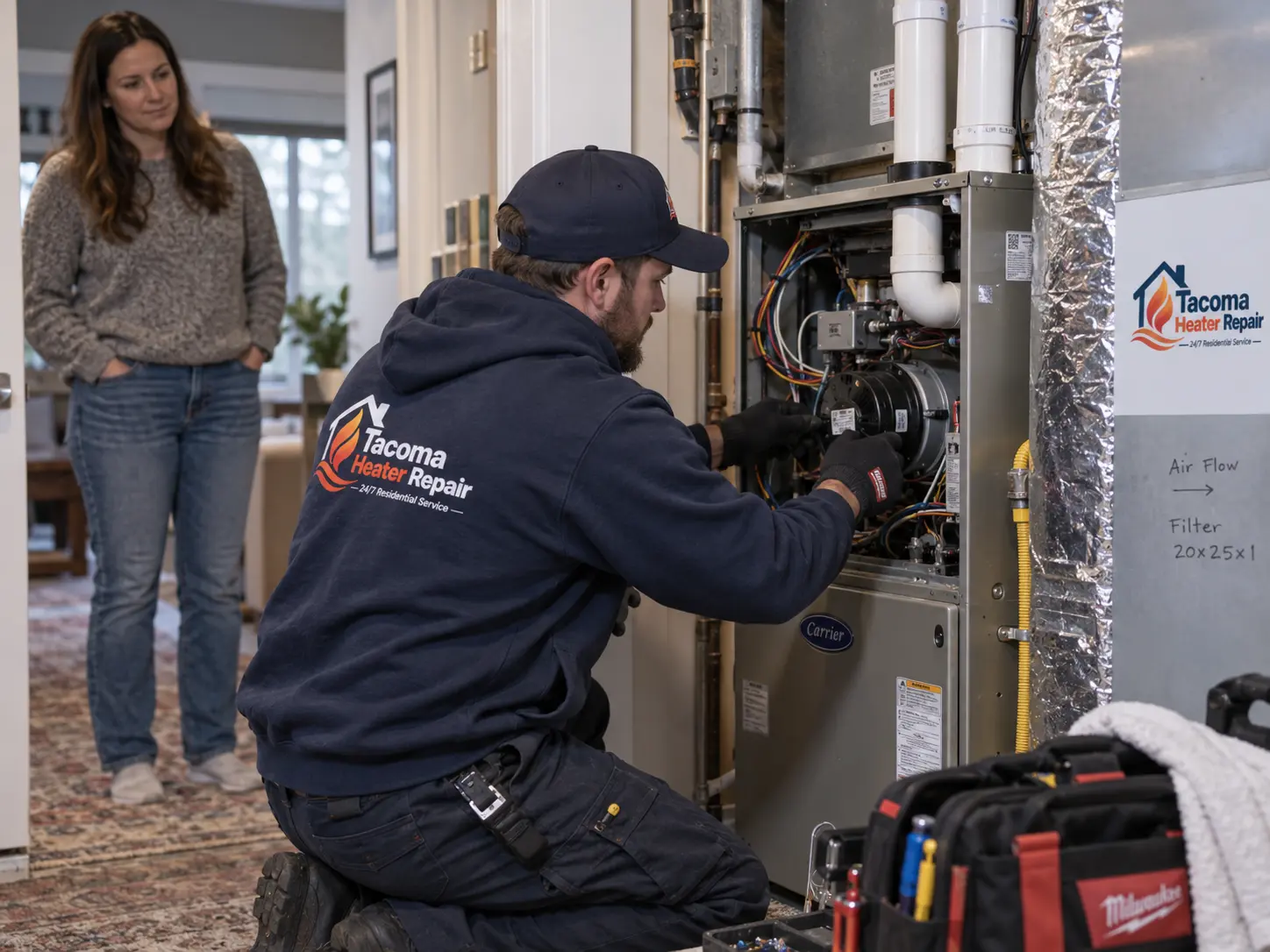
A heater that starts, runs briefly, shuts down, and starts again a few minutes later is usually not malfunctioning at random — it's protecting itself. Heating equipment is built with safety devices that interrupt operation when a condition goes out of range, and short cycling is what that protection looks like from inside the house. The job is to find out what condition keeps triggering it.
Airflow restriction: the most common cause
Furnaces are designed around a specific airflow across the heat exchanger. Take that airflow away and the exchanger overheats within minutes, the high-limit switch interrupts heating, and the blower runs on to cool things down. Once temperatures fall, the cycle repeats. The usual culprits are a loaded air filter, closed or blocked supply registers, furniture or rugs over a return grille, a crushed flexible duct, or a badly undersized filter upgrade that looks better on paper than it performs.
Because Tacoma's heating season is long and damp, filters load faster than homeowners expect and systems accumulate far more run hours than in warmer regions. Checking the filter first costs nothing and resolves a meaningful share of these calls.
Thermostat location and wiring
A thermostat is a temperature sensor making decisions for the whole house, so where it sits matters. Direct sunlight, a nearby supply register, a drafty exterior wall, or a spot above a heat-producing appliance all feed it misleading readings. Add a loose or chafed thermostat wire, a corroded terminal, or weak batteries, and heat calls become intermittent. Advanced thermostats with aggressive cycle-rate settings applied to the wrong equipment type can also produce cycling that looks mechanical.
Flame sensor and ignition faults on gas furnaces
A gas furnace confirms flame through a flame sensor. When that sensor is coated with oxide, the control board sees no flame, shuts the gas valve, and retries — producing a distinctive pattern of ignition, a few seconds of burn, shutdown, and retry, usually ending in lockout after several attempts. A weak igniter, a marginal gas valve, or a pressure switch that opens partway through a cycle produce similar patterns. This is diagnostic work, not a reset-button fix.
Blower and motor problems
If the blower can't move its designed volume of air — a failing motor, a weak capacitor, a slipping belt on older equipment, a wheel packed with dust — the result is the same as a restricted duct: overheating and limit trips. A motor drawing too much current can also trip its own thermal overload, drop out mid-cycle, and restart once it cools.
Condensate and venting on high-efficiency systems
High-efficiency condensing furnaces produce water, and that water has to drain. A clogged condensate trap or line, a float switch doing its job, or a blocked or partially obstructed vent will open the pressure switch and stop combustion — often intermittently, which reads as short cycling. In a climate as wet as ours, condensate and venting deserve attention on any cycling complaint involving a condensing furnace.
Heat pumps and defrost
Heat pumps cycle into defrost by design, and in Tacoma's near-freezing damp weather they may do so fairly often. Defrost every thirty to ninety minutes in those conditions can be normal. Defrost every few minutes, or a unit that ices over and never clears, indicates a sensor, board, airflow or refrigerant-charge problem. A failing outdoor fan motor or a badly blocked coil will also cause pressure-driven cycling.
Oversized equipment
A system with much more capacity than the home needs satisfies the thermostat quickly, shuts off, and repeats. This shows up most often after a replacement that was sized by rule of thumb rather than by load calculation, or after significant insulation and window upgrades left the original equipment oversized for the house. It's not a broken part, and it can't be repaired away — but it can be improved with staging, fan settings and thermostat configuration.
What you can check safely
- Replace the air filter if it's dirty, and confirm the airflow arrow direction
- Open every supply register and clear anything blocking return grilles
- Move lamps, electronics and furniture away from the thermostat
- Fit fresh batteries in a battery-powered thermostat
- Clear leaves, snow and debris from an outdoor heat pump unit
- Time a few cycles and note the pattern — it's genuinely useful diagnostic information
Don't bypass a limit switch, a float switch or a pressure switch to keep the system running. Those devices exist to prevent overheating, water damage and combustion hazards, and defeating them converts a repair into a risk.
If the free checks don't settle the cycling, have the system tested properly — temperature rise, static pressure, the full ignition sequence, motor current draw, and the safety circuit. We work on homes only, 24 hours a day, across Tacoma and nearby communities. You can also see residential heater repair or get a planning range from the cost calculator.
FAQ
How long should a normal heating cycle last?
Most residential systems run roughly ten to twenty minutes per cycle in typical Tacoma winter weather. Cycles of two to five minutes, repeating, point to a fault rather than mild weather.
Is short cycling damaging?
Over time, yes. Startup is the hardest moment for motors, igniters and controls, so a system that starts many more times per day than it should wears out sooner and heats less evenly.
Can a thermostat cause short cycling?
Yes. A thermostat in direct sun, near a supply register, on an exterior wall, or with a wiring or calibration fault will satisfy or call for heat at the wrong moments and cut cycles short.