Homeowner guide
Why Is My Heater Blowing Cold Air in Tacoma?
Air is moving but it isn't warm. Here are the causes we actually find in Tacoma homes, in the order worth checking them.
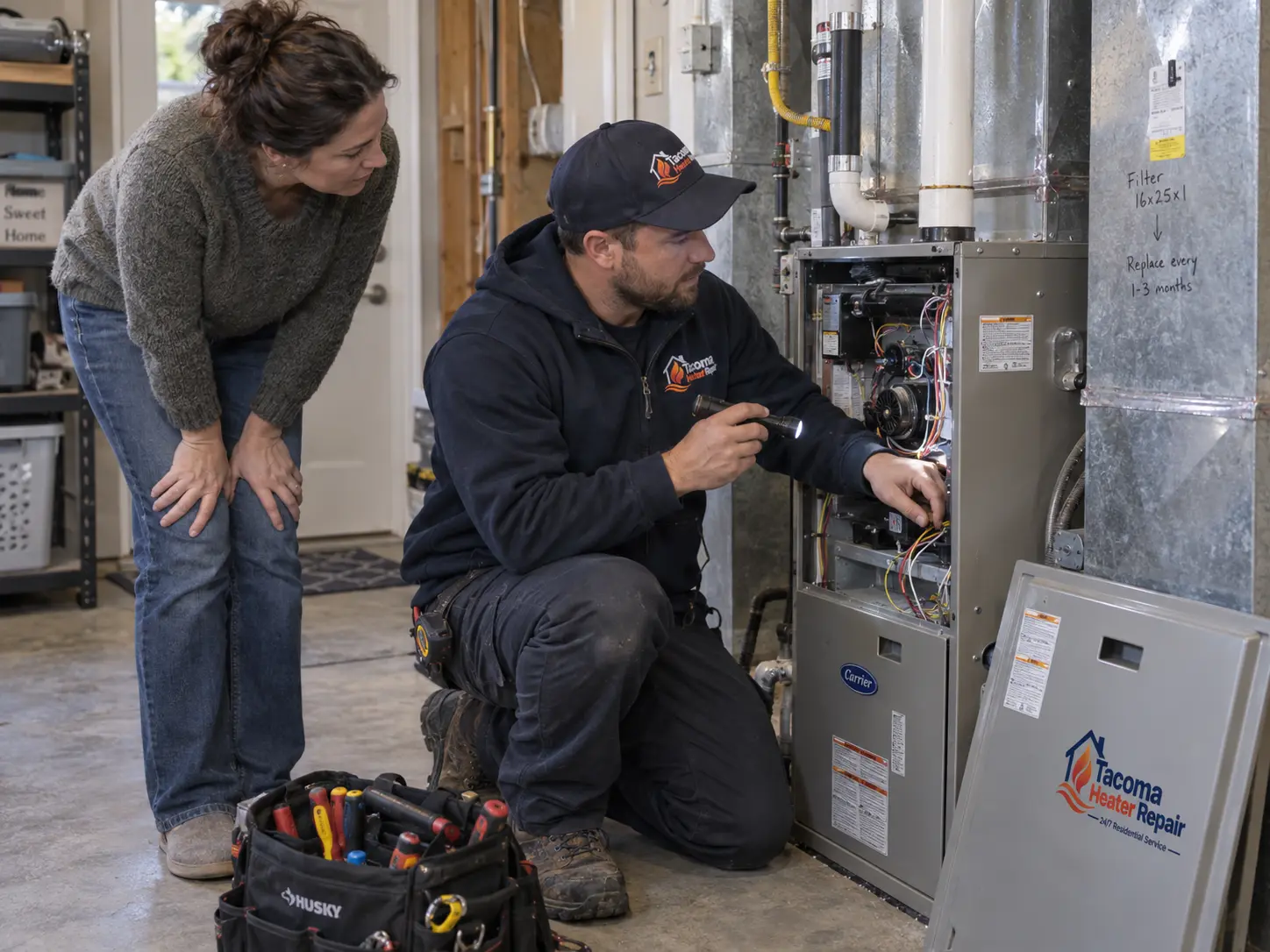
Cold air from the vents is one of the most common no-heat calls we take in Tacoma homes, and it's also one of the most misread. Air is moving, the system sounds like it's working, so it seems like a small problem — yet nothing in the house gets warmer. What's usually happening is that one half of the system is doing its job while the other half isn't: the blower runs, but heat is never produced, never completes, or has been shut off by a safety device.
Start with the thermostat, because it's free
Check that the mode is set to Heat rather than Fan or Cool, and that the fan setting is Auto rather than On. A fan left in the On position runs continuously and moves room-temperature air between heating cycles — which feels exactly like cold air blowing from the vents. Then check the setpoint: if it's below room temperature, the equipment has no reason to produce heat. On battery-powered thermostats, weak batteries can leave the display lit but the heat call unreliable. Smart and programmable thermostats add one more trap — a schedule or vacation hold quietly holding the house at a low temperature.
Airflow restriction and the limit switch
This is the single most common mechanical cause. A furnace is designed around a certain volume of air passing over the heat exchanger. Restrict that air — a filter that hasn't been changed in months, closed or blocked registers, furniture over a return, a collapsed flexible duct — and the heat exchanger runs hotter than it should. The high-limit switch then interrupts heating to protect the equipment, while the blower keeps running to cool it down. The result at the register is air that starts warm and turns cool partway through the cycle.
Tacoma's long heating season makes this worse than in drier climates, simply because systems run for months at a stretch and filters load up faster than homeowners expect. If your air starts warm and goes cool a few minutes in, and the pattern repeats, airflow restriction is the first suspect.
Ignition problems on gas furnaces
On a gas furnace, the blower can engage even when the burners never light or don't stay lit. A hot surface igniter that has cracked, a flame sensor coated in oxide that can't confirm flame, a failed gas valve, or a pressure switch that won't close because of a venting or condensate issue — all produce the same symptom from the living room: the system starts, air blows, and it's cool. Sometimes you'll hear the igniter cycle two or three times before the control board locks out. Repeated ignition attempts and lockouts are a service call, not a reset-it-and-hope situation.
Heat pumps: defrost is normal, cold air all cycle is not
Heat pumps are common in newer Tacoma-area homes, and they behave differently. In damp weather near freezing, the outdoor coil frosts and the system reverses briefly to clear it. During that defrost cycle, supply air can feel cool for several minutes — this is normal, and auxiliary heat usually covers it. What isn't normal is cool air for an entire cycle, defrost running every few minutes, ice that never clears, or a reversing valve that fails to switch into heating at all. A heat pump also delivers air cooler than a furnace by design — around body temperature rather than hot — so "not as hot as my old furnace" isn't necessarily a fault. Continuous cool output is.
Electric heat: elements and sequencers
On electric furnaces and air handlers with electric heat, the blower and the heating elements are on separate circuits and controls. A tripped breaker on the heat circuit, a failed sequencer, a burned-out element or an open safety limit leaves you with a system that moves plenty of air and heats none of it. Because nothing sounds wrong, electric heat failures are often the ones homeowners live with the longest.
Ducting and distribution
Occasionally the equipment is fine and the delivery isn't. A disconnected duct in a crawlspace or attic dumps heated air where nobody lives and pulls cold air into the return path. Older Tacoma homes with retrofitted ducting are especially prone to this. The tell is usually uneven — one or two rooms noticeably worse than the rest, and a system that runs much longer than it used to for the same result.
What you can safely check before calling
- Thermostat mode set to Heat, fan set to Auto, setpoint above room temperature
- Fresh batteries in a battery-powered thermostat
- Air filter clean and installed in the correct direction
- Breakers for the furnace or air handler in the On position
- Supply registers and return grilles open and unobstructed
- Outdoor heat pump unit clear of ice, leaves and debris
Stop there. Opening a burner compartment, jumping a safety switch, or touching gas or high-voltage connections is where homeowner troubleshooting turns into a hazard.
Call right away if you notice any of these
- A gas or sulfur smell — leave the home and call your gas utility or 911 first
- A burning or electrical smell, or visible scorching
- A carbon monoxide alarm sounding — get everyone outside and call 911
- Booming, grinding or metal-on-metal noise from the equipment
- Repeated ignition attempts followed by a lockout
If the free checks don't restore warm air, a proper diagnosis is the efficient next step — measuring temperature rise, verifying the heat call reaches the equipment, confirming the ignition sequence completes, and checking the safety circuit rather than replacing parts on suspicion. We work on homes only, 24 hours a day. Read more about furnace repair, electric heater repair, or the parts of a home heating system.
FAQ
Is cold air from the vents always a broken heater?
No. A thermostat set to fan-only, a heat pump in a defrost cycle, or a furnace that has just shut down on a safety switch can all push cool air while the equipment itself is intact. The pattern and timing tell you which it is.
Should I keep the system running if it's blowing cold?
If it is only blowing cool air, running it is uncomfortable but not usually harmful. If you smell gas, smell burning, or hear grinding or booming, shut the system off and call for service.
Can a dirty filter cause cold air?
Yes, indirectly. A restricted filter starves airflow, the heat exchanger overheats, and the limit switch cuts heating while the blower keeps running — so cool air comes out of the registers.