Homeowner guide
How Much Does Heater Repair Cost in Tacoma, WA?
There's no single price, but the factors behind the number are knowable. Here's what shapes the cost of a residential heating repair.
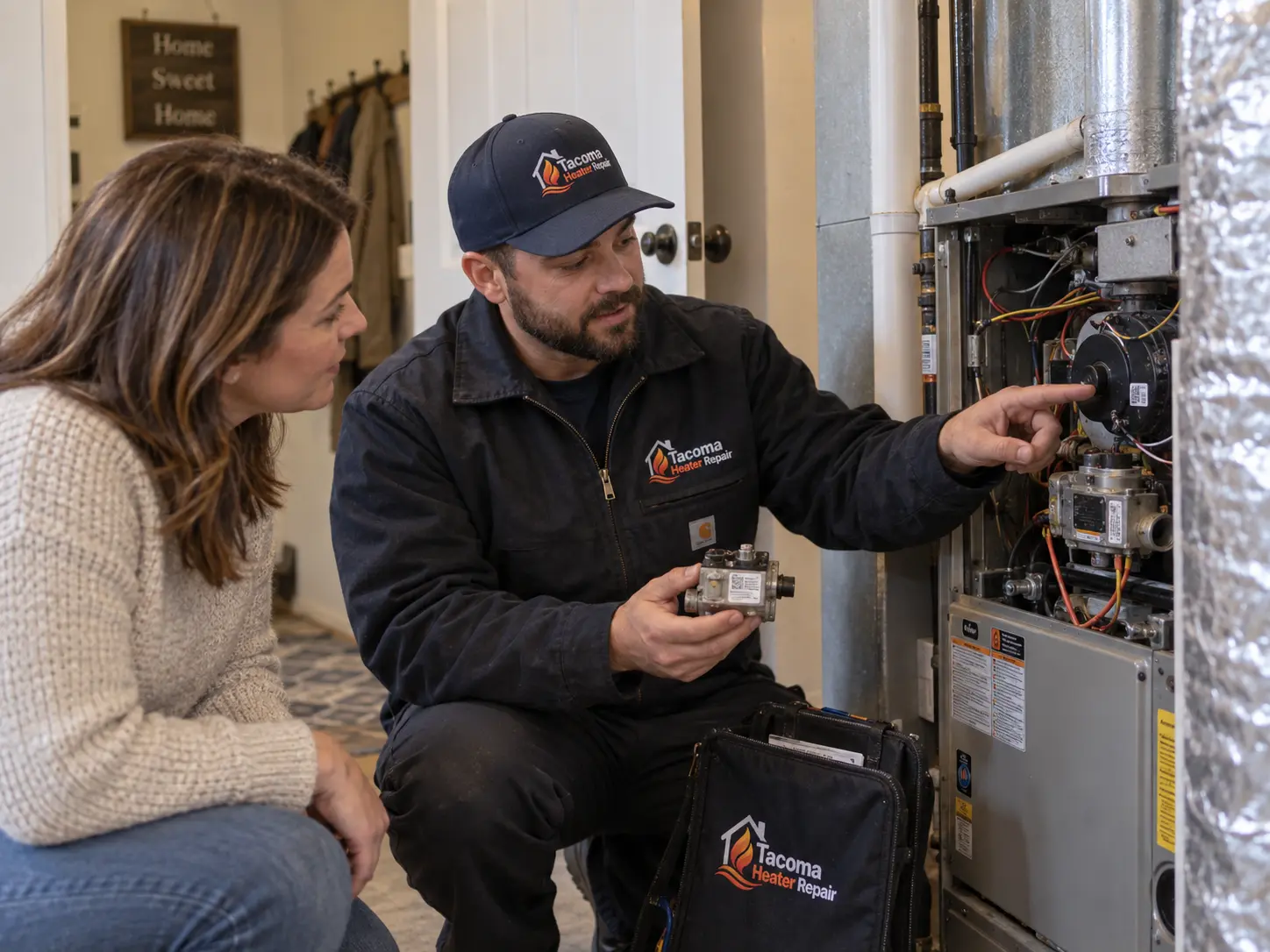
"What will this cost?" is the first thing most homeowners want to know, and the honest answer is that it depends on what's wrong — but the factors that drive the number aren't mysterious. Understanding them puts you in a much better position to judge a quote, decide between repair and replacement, and avoid paying for work that wasn't necessary.
1. What kind of system you have
A gas furnace, an electric furnace, and a heat pump fail in different ways and carry different parts. Gas equipment brings igniters, flame sensors, gas valves, pressure switches and inducer motors into the picture. Electric heat brings elements, sequencers, relays and contactors. Heat pumps add refrigerant circuits, reversing valves, defrost boards and outdoor fan motors, and refrigerant work requires certification and specialized equipment — which generally makes it the more involved category.
2. Which component actually failed
This is the biggest single variable. Replacing a thermostat, a flame sensor, a capacitor, a filter or a fuse sits at the low end of any repair scale. Blower motors, control boards, gas valves, inducer assemblies, heat exchangers and compressors sit at the high end — both because the parts cost more and because getting to them takes real labor. Two homes with identical "no heat" complaints can land at opposite ends of that range.
3. Diagnostic time
Some faults announce themselves in ten minutes. Intermittent ones — a system that works fine until 3 a.m., a limit switch that only trips on the coldest nights, a thermostat wire chafed somewhere in a wall — take longer to isolate. Time spent finding the real cause is time well spent, because the alternative is replacing parts that weren't broken.
4. Access
Tacoma's housing stock ranges from century-old homes with equipment tucked into tight basements to newer houses with attic air handlers and crawlspace ducting. A furnace with clear working room around it is a faster repair than the same furnace in a closet with three inches of clearance, or an air handler reached by crawling across joists.
5. Parts availability
Common components for current equipment are usually on hand or available locally. Parts for older or discontinued systems can require ordering, and in some cases the original part no longer exists and an adapted replacement is the only path. Both affect total cost and timeline.
6. Urgency and timing
A scheduled daytime appointment is the most economical option. Same-day and after-hours response costs more, for the straightforward reason that it reprioritizes the day. When your home has no heat, that premium is often worth it — but you should know it exists, and we tell you when you call. See emergency heater repair for how after-hours calls work.
7. Equipment age and condition
Older systems tend to cost more to repair, not because of the age itself but because surrounding components are also near the end of their service life, brittle wiring and corroded fasteners slow the work, and a single failure is often a symptom of general wear. On an old system it's worth asking what else the technician noticed, not just what was fixed.
What a fair process looks like
- Diagnosis before pricing — the fault identified and explained, not guessed at
- A quote you approve before any repair work begins
- The reasoning stated plainly: what failed, what it affects, what the fix involves
- Related findings disclosed, not quietly bundled into the invoice
- An honest replacement conversation when repair stops making sense
Repair or replace?
There's no universal cutoff, but the factors that tip the balance are consistent: the age of the equipment, whether this is the third failure this season or the first in a decade, whether the failed component is a major one, and whether any combustion-safety concern has been found. A cracked heat exchanger or a failed compressor on old equipment usually reframes the conversation entirely. A capacitor on a ten-year-old furnace does not.
Getting a planning number now
Our heater repair cost calculator produces a deliberately broad planning range from your system type, the problem you're seeing, urgency and equipment age. It's for budgeting, not a quote — actual pricing follows diagnosis at your home. Quotes are free; call 253-215-2765 and we'll walk through what to expect for your situation.
FAQ
Why can't a heater repair be priced over the phone?
The same symptom has several possible causes with very different parts and labor. Pricing follows diagnosis, which is why we quote after testing the system rather than before.
Does a 24/7 call cost more than a scheduled visit?
After-hours and same-day emergency response is generally priced higher than a scheduled appointment. We tell you the terms when you call so the choice is yours.
When is repair no longer the better value?
When an aging system has repeated failures, a major component like a heat exchanger or compressor fails, or a combustion-safety issue is found, the repair cost starts approaching replacement value and it's worth comparing both.