Homeowner guide
What to Do When Your Heater Stops Working at Night in Tacoma
A no-heat evening has a short list of safe checks, a shorter list of warning signs, and one clear point to stop and call.
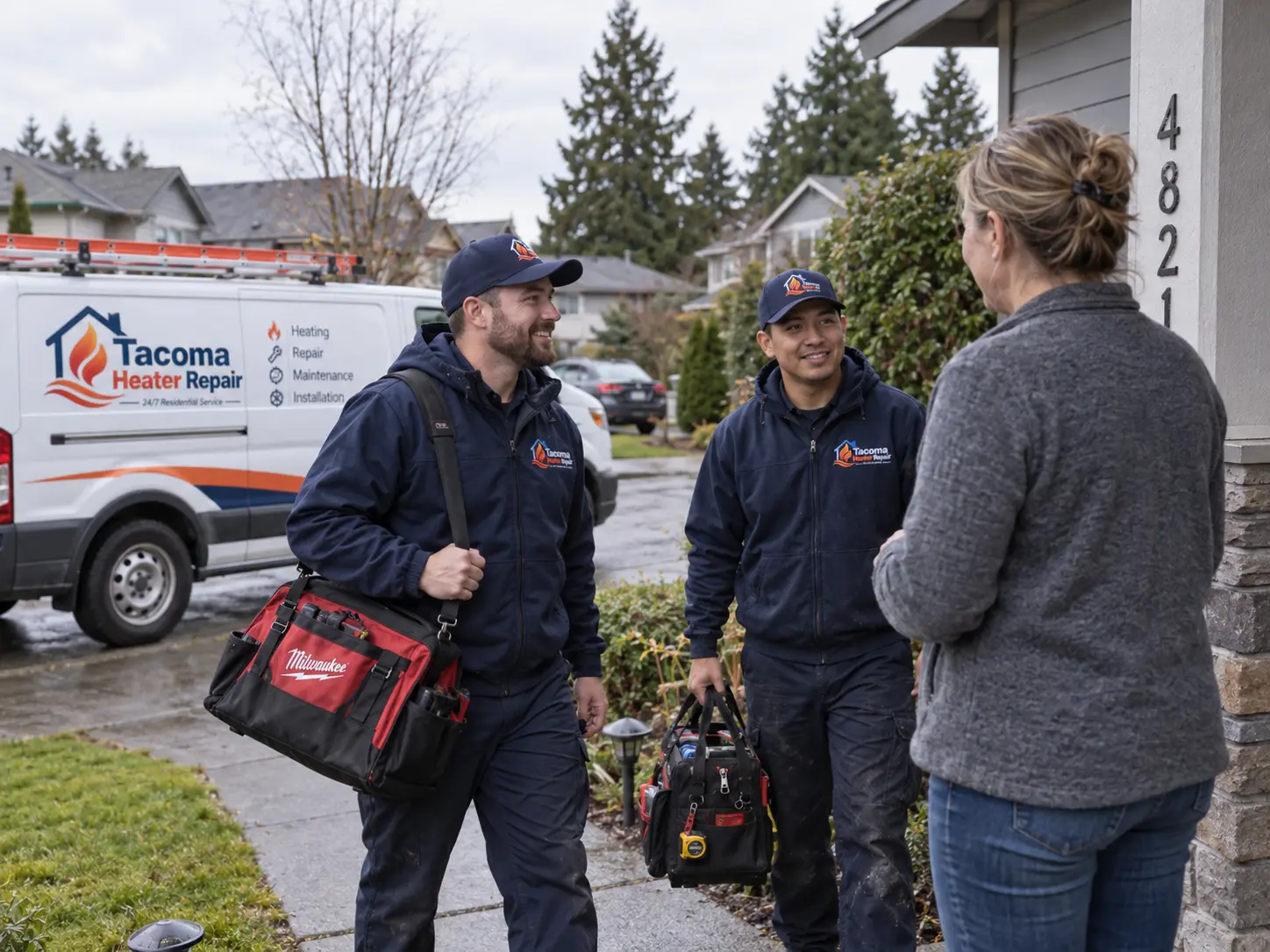
Heat almost never fails at a convenient hour. Tacoma's winter nights sit in the thirties and forties with damp air that makes them feel colder, and a house without heat loses temperature steadily after dark. The good news is that a no-heat night has a short list of safe checks, a shorter list of warning signs, and a clear point at which to stop and call.
First: rule out a hazard
Before troubleshooting anything, check for these. If any are present, stop and act immediately:
- Gas or rotten-egg smell: get everyone out of the house, don't switch lights or appliances on or off, and call your gas utility or 911 from outside.
- Carbon monoxide alarm sounding: get everyone outside into fresh air and call 911. Don't re-enter to investigate.
- Burning, smoke or electrical smell: shut the system off at the breaker and call for service.
- Sparking, arcing or a breaker that keeps tripping: leave the breaker off and call.
Then: the safe five-minute checklist
- Thermostat. Heat mode, fan on Auto, setpoint above room temperature. Check for a schedule or vacation hold. If the display is blank or dim, try fresh batteries.
- Breaker. Look for a furnace or air handler breaker that's off or tripped, and reset it once. If it trips again, leave it off.
- Furnace switch. Many systems have a light-switch-style service switch near the equipment that gets flipped by accident during storage or cleaning.
- Filter. If it's visibly dirty, replace it. Restricted airflow is a real cause of overnight shutdowns, not just a maintenance nicety.
- Registers and returns. Open supply registers and clear anything covering return grilles.
- Outdoor unit, if you have a heat pump. Clear leaves and debris. Note whether it's iced over — and don't chip at ice or pour hot water on the coil.
That's the whole safe list. Don't open a burner compartment, don't bypass a safety switch, don't touch gas piping or high-voltage wiring, and don't run a system that smells wrong.
Staying warm while you wait
- Close off unused rooms and keep interior doors to occupied rooms closed
- Close curtains and blinds — glass is where a house loses heat fastest at night
- Gather everyone into one room, ideally on an interior wall away from windows
- Layer clothing and blankets; a warm hat helps more than people expect
- Warm drinks and food help; so does keeping mildly active rather than sitting still
If temperatures are near or below freezing, open cabinet doors under sinks on exterior walls and let a faucet drip to reduce the risk of frozen pipes. Never heat a home with a gas oven, a charcoal or propane grill, a camp stove, or a generator indoors or in a garage — all of them produce carbon monoxide.
Space heaters, used carefully
Portable electric heaters are a reasonable stopgap with strict rules: plug each one directly into a wall outlet, never into an extension cord or power strip; keep three feet of clearance from bedding, curtains, upholstery and paper; place them on a hard, level surface where they can't tip; use models with tip-over and overheat protection; and turn them off before everyone sleeps. Don't run several on the same circuit — that's how breakers trip and cords overheat.
When to call instead of waiting for morning
- Indoor temperature is falling and won't hold a safe level
- Infants, older adults, or anyone with a medical condition is in the home
- Outdoor temperatures near or below freezing, with pipe-freeze risk
- The system is making unusual noise, or repeatedly ignites and locks out
- A breaker trips again after one reset
- You've done the safe checks and there's still no heat
What to have ready when you call
Your address and 5-digit ZIP code, the type of system if you know it, what the system is doing (nothing at all, blowing cool air, cycling on and off, unusual noise), when it started, and anything you've already tried. It shortens the call and helps us arrive prepared.
Tacoma Heater Repair answers residential heater repair calls 24 hours a day across Tacoma and nearby communities — call 253-215-2765. You can also read about emergency heater repair or check a planning range for the repair.
FAQ
Is a no-heat night an emergency?
It can be. Cold overnight temperatures, infants, older adults, anyone with a health condition, or indoor temperatures that keep falling all make it urgent. Any gas smell, burning smell or carbon monoxide alarm is an immediate emergency.
Can I use space heaters overnight?
Use them cautiously: one per outlet, never on an extension cord or power strip, at least three feet from bedding, curtains and furniture, on a hard level surface, and never left running in a room where everyone is asleep.
Do you really answer calls at night?
Yes. Tacoma Heater Repair answers residential heater repair calls 24 hours a day. When you call we confirm current availability for your address rather than promising a window we can't hold.